

Riding Pillion
Reflections on the film, and Adam Mars-Jones' 'Box Hill'

Tom and I braved the New York winter to the Angelika on Houston Street to catch Pillion on its U.S. opening weekend, with our Schott leather jackets, grey hanky dangling from our jeans pocket. We had been hearing so much about the film since its festival premiere, and in the weeks leading up to its opening the algorithm flooded our feeds with Alexander Skarsgård doing the rounds on late night interviews, SNL, and thirst trap teasers from the film. We had been edged for some time and we were more than ready for our release.
After the film, as the credits rolled, we exchanged looks. There was a lot to process and it was not what we expected, even though we were not quite sure what we had desired from it. The online kink community already seems divided in its responses. There were moments watching the film with a non-kink audience where it felt like the laughter in the theater was directed at the characters and their proclivities, rather than alongside them.
If you have not yet seen the film (or read the book it is based on) and would prefer to avoid spoilers, stop reading now and come back after you do.
Pillion bears the burden of representation it was expected to carry. It is rare to see an A-list celebrity portray a gay, kinky character in a film produced by a celebrated independent studio like A24. This story, our story, is hardly given the cinematic treatment, and when it is, it tends toward lurid sensationalism or camp spectacle. Think Cruising (1980) featuring Al Pacino, or Querelle (1982) by Rainer Werner Fassbinder. For that alone, the film deserves credit: it centers a kink romance and situates it within the textures of everyday life, rendered in a world that feels relatively realistic.
To understand what the film is reaching for, and where it falls short, it helps to start with the source material. Tom read Adam Mars-Jones’ Box Hill before seeing the film; I read it after. A volume slim enough that it is possible to finish in one sitting. The subtitle A Story of Low Self-Esteem frames expectations and firmly announces the protagonist of the story as Colin Smith. The novel serves as a powerful companion to the film, and perhaps the film’s greatest contribution is that it will draw more readers to the book and the writing of Adam Mars-Jones. The story begins in the 1970s in Box Hill, Surrey, right by the A24 expressway. Coincidence? Perhaps.

The novel is told in first person, and its narrator moves fluidly across time, layering memory with retrospection. Midway through, Ray, the biker-dom, is killed in a motorcycle accident while Colin is away on holiday with his parents. When Colin returns and tries to contact him, members of Ray’s riding gang inform him of the death, offering few details beyond that. From that point on, the narrative becomes a meditation on coping with sudden and inexplicable loss.
Colin learns to live with absence, with the gap in knowledge that can never be filled. He returns to the apartment he shared with Ray, only to discover that he has been locked out, having never been given a key. He hears from a neighbor that Ray’s mother removed all of his shared possessions and burnt the rest of his presumably kinky paraphernalia in a fire in the backyard. They had been together for six years. The novel situates this grief as preempting the mourning and melancholia of the AIDS era, and the quiet persistence of survivors’ guilt. It mirrors the shame that surrounded so many AIDS-related deaths of the time: families moving swiftly in to expunge any trace of a life they found shameful, cutting off access to partners and friends.
The Colin of the novel works as a train operator - from riding pillion on motorcycles to bracing for suicidal jumpers on the tube. And even if it is not explicitly framed as such, the devotion Colin has for Ray is paralleled in the devotion Colin’s mother had for his father, who passed away earlier. The novel elegantly de-exceptionalizes kink, and situates it alongside everyday life.
Discriminating is just what they’re doing by making out that two different things are the same. (Box Hill)
Where the novel truly shines is in its fine-grained attention to the minutiae of kink life, which is, in its own way, a durational endurance exercise. After the leather event, who buffs and shines the gear? And what does it mean to remain devoted to something that no longer exists? Colin’s devotion to a deceased Ray may be the most devastating sadistic dynamic of all: a dominant and submissive relationship that can never reciprocate, only haunt.
These mundane activities of maintenance are as significant as the spectacle itself. The repeated motif of candle wax lubricating thick zippers on jackets. The ritual and discipline of cleaning the motorcycle. Alongside the protagonist’s gradual realization that kink, like grief, is a practice lived in tandem with the rest of life, these details lend the novel a striking sense of realism. It reads almost too precisely and pragmatically to be fiction. This is clearly from a writer who understands the exploration of kink and life.
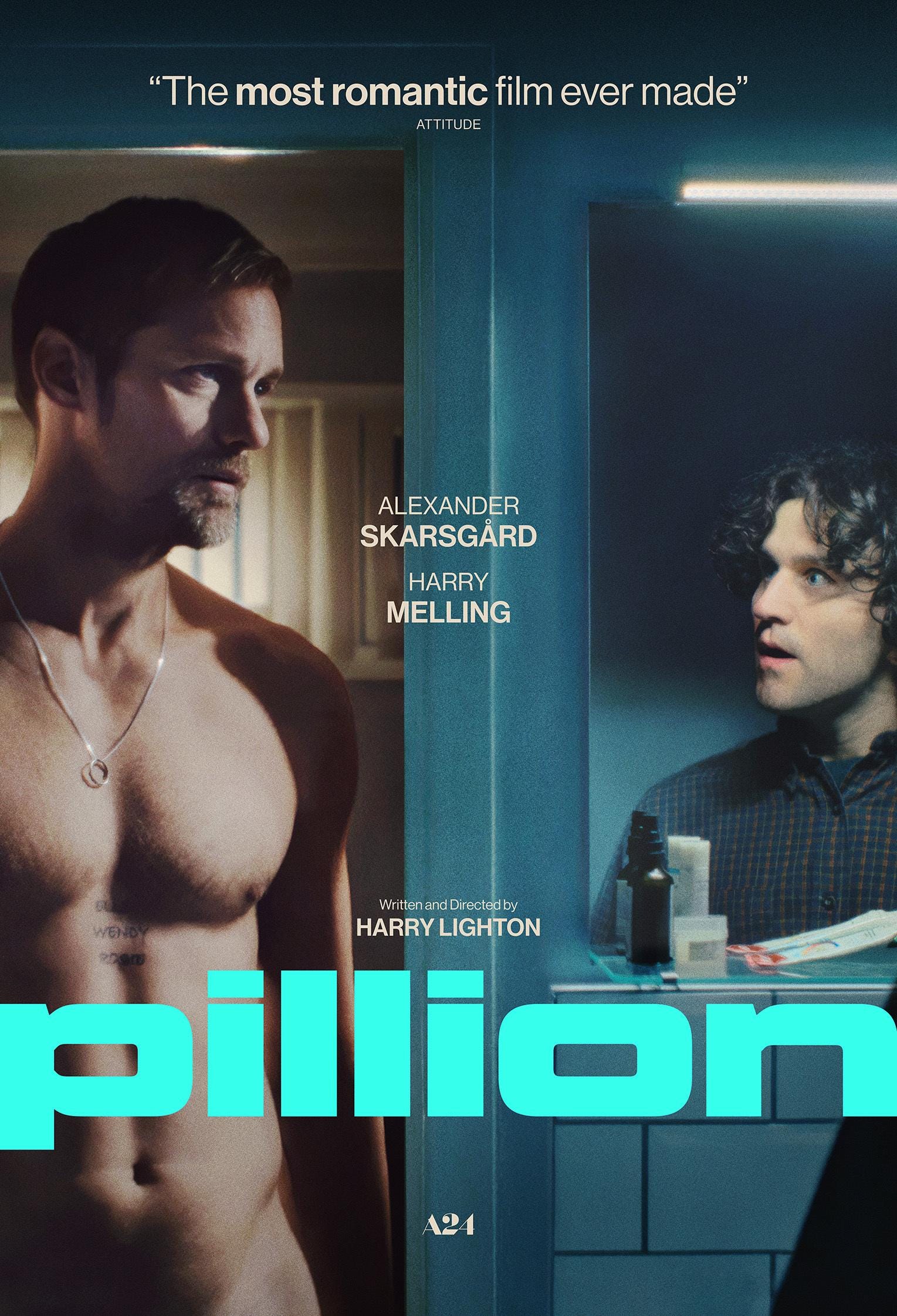
The film transposes the story to present-day London, a shift that was apparently driven by budget constraints. Colin the train operator becomes the Colin the despised parking attendant that issues summons. This is understandable for an independent production, but the transposition of time flattens something important. The novel’s 1970s setting grounds Colin’s grief in a historical moment when queer loss was systematically erased, when families could and did disappear the evidence of lives they refused to acknowledge. Set in the present, with Grindr and a more visible contemporary kink culture as backdrop, that specific weight is harder to access. Aesthetically it got a lot of the visuals right: The Cellblock13 assless wrestling singlet. The oversized chunky lock and chain, the skin-tone transparent latex, the puppy hoods. The kink community recruited to be peripheral characters in the film were really outfitted in their Sunday best. The modernizing of Skarsgård’s silhouette with a moto-suit from Hideout Leather was also a great decision by the costume designer Grace Snell.
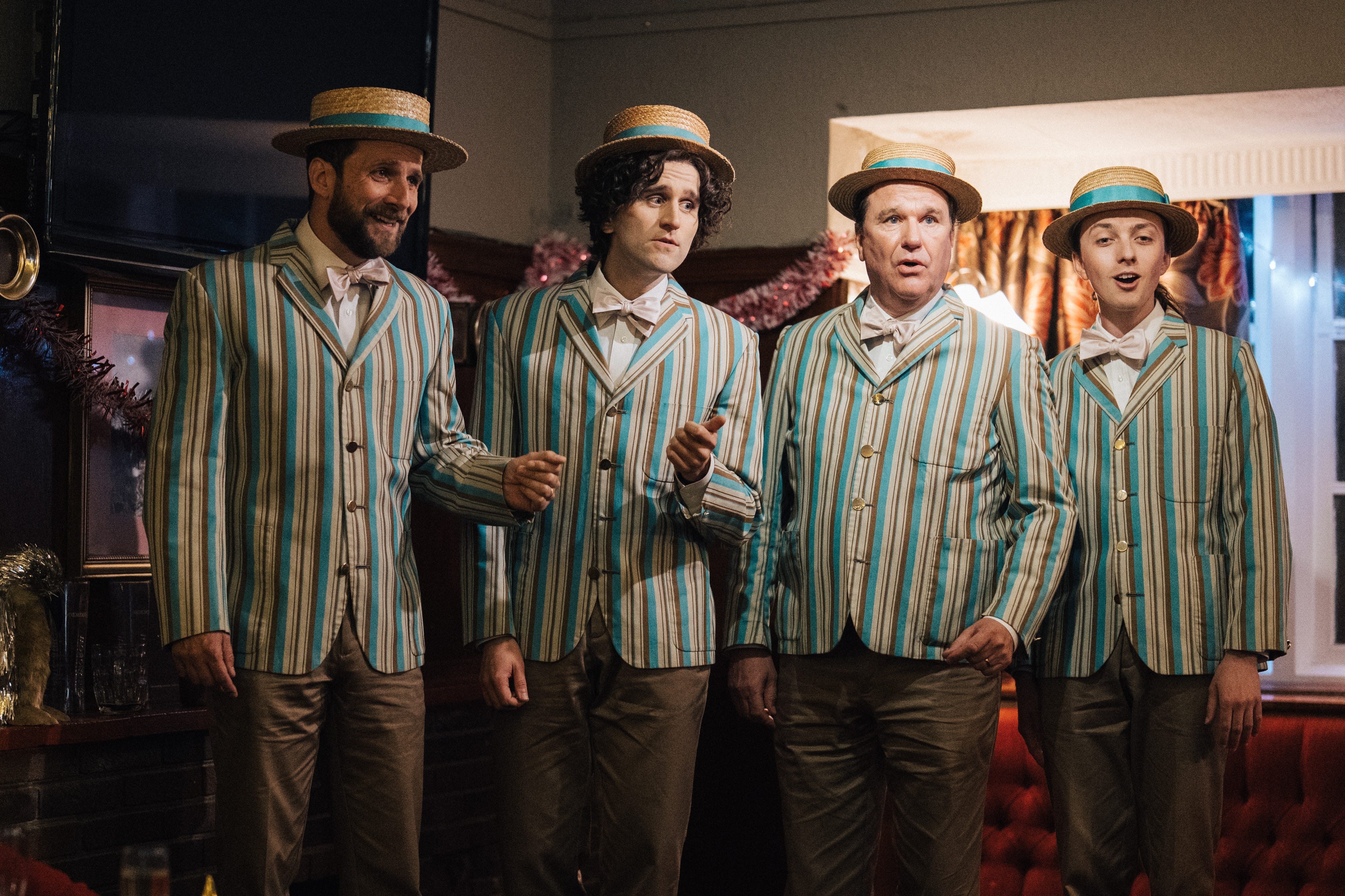
There were other updates that did not work as well, the most significant difference is one of form. The first-person narrative gives the book its intimacy and its cumulative power. His agential capacity, even in moments when he is surrendering them, is never in doubt. The film might have benefitted from staying closer to Colin’s point of view to clarify whose story it is. We could have seen more of the world through his eyes, or felt more firmly grounded in his character. But when your co-star is Alexander Skarsgård, and the camera clearly adores him, it is hard to hold one’s ground (or attention). Without seeing the world through Colin’s perspective, it is hard to understand his motivations. Harry Melling who plays Colin Smith has a beautiful singing voice, but writing his character into a barbershop quartet pushes him further into the realm of the goofy, socially awkward caricature he is already in danger of becoming. It contributes to several uncomfortable moments during our screening in which the audience seemed to be laughing at him rather than with him, and implicitly at the peculiar arrangements of kink power relations.
And then there is the crucial question of Ray’s fate. In the novel, he dies. In Pillion, his death is brutally rewritten as an abandonment, an abdication of responsibility. The film version of Ray freaks out after Colin requests a day off from the Total Power Exchange 24/7 lifestyle they share. Ray grants Colin his wish, and they lead one perfect homonormative day as a regular gay couple. Then Ray ghosts him, moves out of the apartment, and leaves Colin to pick up the pieces. The Colin of the film goes on Grindr to find his next dominant, and the film concludes with him starting another relationship, seemingly perpetuating the toxic cycle with limited character transformation.
This is highly unsatisfying, even without the knowledge of the book’s remarkably different take. We do not expect our characters to be perfect role models, but we do need them to be consistent for verisimilitude. In the moment when Colin requests a break from the power exchange dynamic, the convincing world-building of leather kink life collapses upon itself. It is out of character for Colin, if he truly is drawn to the lifestyle and derives pleasure from it, to initiate this ultimatum, or to seek wilful attention by burning himself deliberately on the stove. It is also highly unlike Ray, established as an assertive, self-assured, meticulous dominant, to abandon his charge so flippantly. The key line in both book and film is Ray admitting upon his first encounter with Colin paternalistically: “What am I going to do with you?” This is a man who has taken on the weight of responsibility for another person’s submission. It is uncharacteristic for an experienced dominant to walk away, as much as it is inconsistent for an obedient submissive to rebel.1
Some kink folks have critiqued the film for its display of non-consensual consent, or by normative standards, what appears to be an abusive relationship. Personally, that is less of an issue. We do not need all films to uphold the ethical and moral responsibility of portraying consensual, communication-centric kink life. We do not hold the same expectations toward heteronormative films, so why do we expect them for kinky ones? In the book, Colin describes his first sexual encounter with Ray as rape. In fact, as much as it was uncomfortable to watch, the film toned it down quite significantly. Kink is about pushing against norms and boundaries, in pursuit of pleasure and a state of overwhelm, and through that hopefully transformation. Will the non-consensual power exchange sex scenes benefit from establishing a clearer point of view? Perhaps. The “figure things out as we go along” dynamic is quite reminiscent of my gay kink experiences, especially in places without the pedagogical support of a community.
Speaking of community, a final note of what I thought the film scored relatively well on - representing of the larger and diverse network of gay kinksters. The alternate chosen family kinship structures, the sharing of bodies and pleasures that was faithful to the novel. It probably helped to cast folks who appear to be practitioners or had proximity to kink, and according to publicity materials, to consult the Gay Biker Motorcycle Club in the U.K.
A faithful representation of kink is perhaps the unfair expectation I had for Pillion, or at least that it might provide a window for non-kink folks to approach certain aspects of it. It is a memorable directorial debut. The film hits the mark occasionally: the motorcycle maintenance, the weight of leather, the quiet negotiation of lead and follow. But it misses on some things that matter most. For me, the crux of kink, beyond an “aptitude for devotion”, is showing up even after the party has ended, understanding how to braid it into your life, and to have the discipline to persist in the face of great loss.
Box Hill understands that kink, like grief, is not an event but a practice. Pillion comes close, but is inevitably shaped by the economies of independent cinema, marketed as a “dom-com” and carried on the shoulders of actors whose presence both amplifies and limits what the film can hold.
After all that edging, Pillion is ultimately a ruined orgasm - but you cannot deny the pleasures it still brings once you yield (and for others this might be the very experience they seek).
Further Reading:2
Adam Mars-Jones on the adaptation of his novel.
Adam Mars-Jones on the road to Cannes for Pillion.
Interview Magazine’s interview between Harry Lighton and Juan A. Ramírez.
Superfan Mr. Q, a fellow Asian kinkster’s first and second piece about Pillion.
Nick Levine’s BBC Culture piece about the film dividing audiences.
Adding an addendum for clarity, as a few people reached out in response to this. “Consistency” in character-building is inherently subjective, particularly in the context of a kink relationship, which can be expressive in ways that resist normative relational scripts. I was not expecting the forms of communication or transparency often modeled in more conventional on-screen relationships. My critique concerns this character within the internal logic of the film. For me, the portrayal felt incongruent with the world the filmmaker constructs, or at least insufficiently scaffolded within the cinematic language of Pillion.
I am adding to this list as I continue to find them. Send me some if you have any.
Just watched and was looking for reflections on the awkward tension I felt throughout the film. Thanks for this piece! It hit on a lot of interesting themes and the source material coverage was great. I think the movie tried to establish the relationship dynamics very quickly and in a dramatic fashion. The characters had to be one-dimensional in order for growth but that meant early on in the relationship there was no communication; something I found concerning at best. I wanted a degree of negotiation up front, but recognize that might not always happen or be desired.
Love this 💚